Artificial football turf has become the standard solution for modern sports infrastructure across professional clubs, schools, public stadiums, and commercial training facilities. Compared with natural grass, synthetic football turf offers significantly higher usage capacity, lower maintenance requirements, and more stable year-round performance.
However, one of the most common questions from project owners is simple: how long does an artificial football turf actually last?
The answer depends on much more than just the turf surface itself. A football field is an engineered system where turf fiber quality, shock absorption layers, drainage structure, installation precision, and usage intensity all directly influence long-term durability and lifecycle cost.
In most cases, a properly designed artificial football turf system can last between 8 and 15 years. High-performance FIFA-level systems with professional engineering standards can often maintain stable playability for even longer under controlled maintenance conditions.
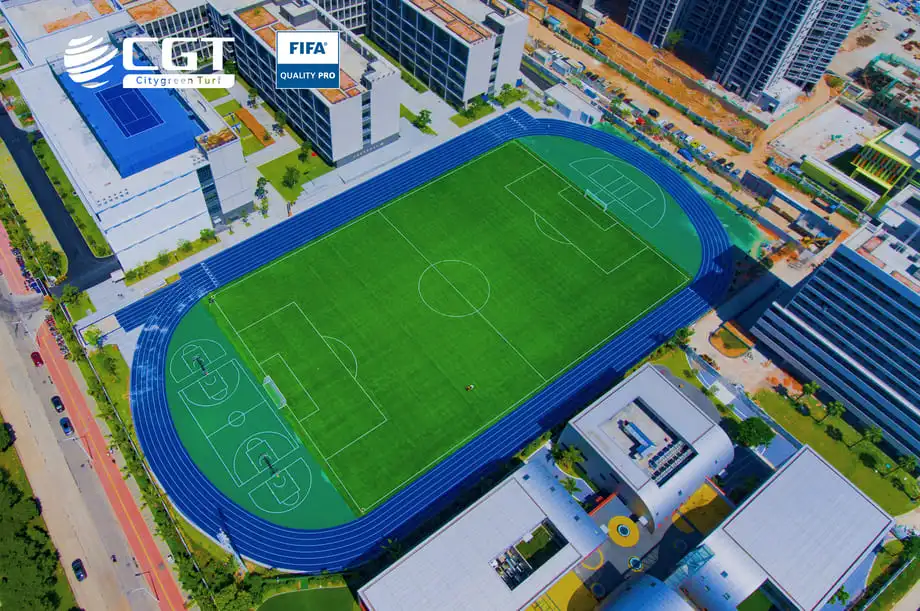
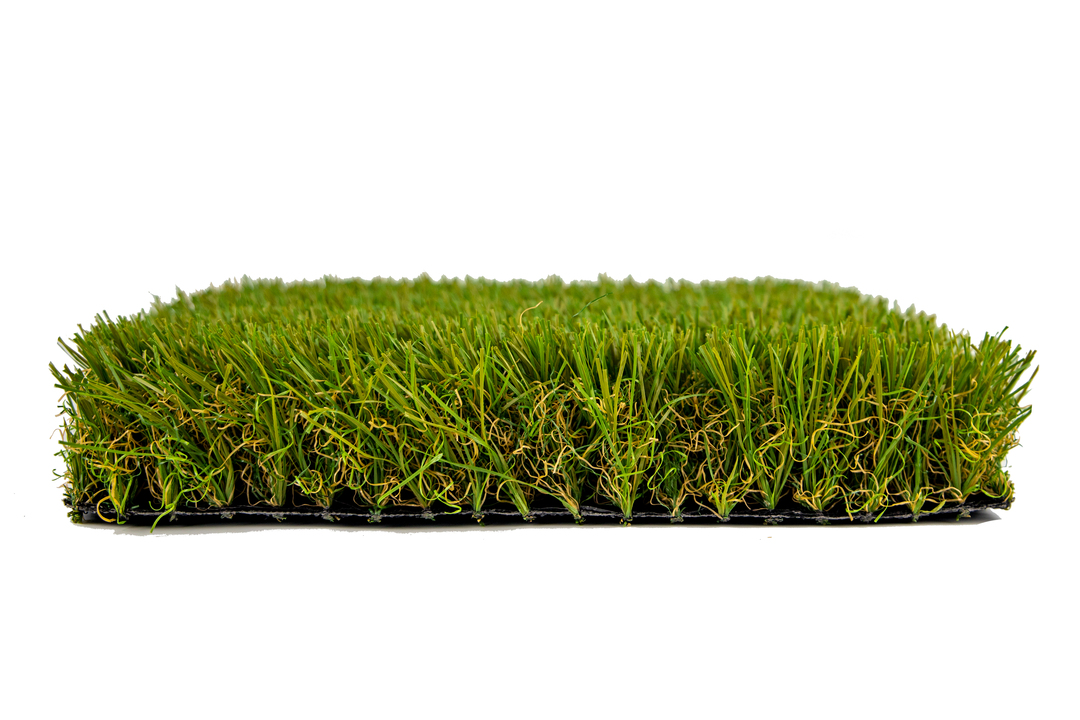
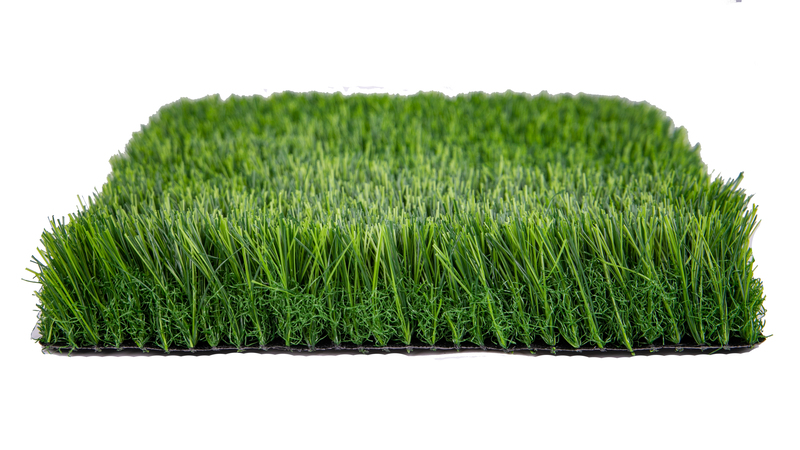
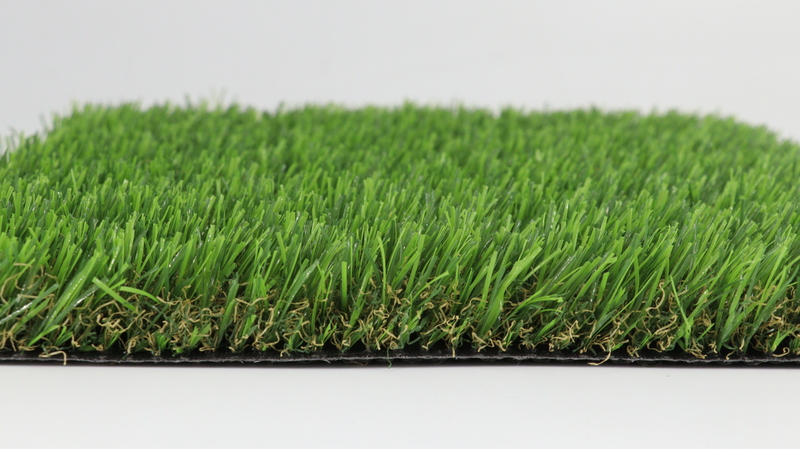
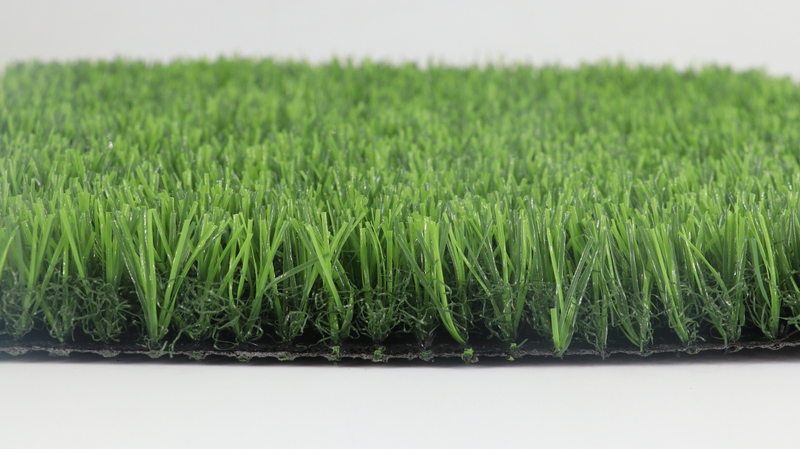
professional artificial football turf field designed for long-term durability
Average Lifespan of Artificial Football Turf
The average lifespan of an artificial football turf field typically falls within the following range:
- Standard recreational football turf: 8–10 years
- Commercial training or school fields: 10–12 years
- FIFA-quality professional systems: 12–15 years or more
The actual replacement cycle is influenced by both structural durability and playability performance. In many projects, the field may still appear visually acceptable after several years, but ball rebound consistency, traction, shock absorption, and surface stability may already have declined significantly.
This is especially important for high-frequency football environments where player safety and performance standards cannot be compromised.
Professional systems are therefore designed not only for visual longevity but also for long-term consistency under intensive usage conditions.
At CGT, football turf systems are typically engineered around expected usage intensity from the beginning of the project. Rather than treating the turf as an isolated surface product, the system is developed as a complete sports infrastructure solution that balances durability, drainage efficiency, athlete comfort, and maintenance practicality.
Key Factors That Affect Artificial Football Turf Lifespan
The lifespan of a synthetic football field is determined by several interconnected technical factors.
Usage Frequency
Usage intensity is one of the largest variables affecting turf longevity.
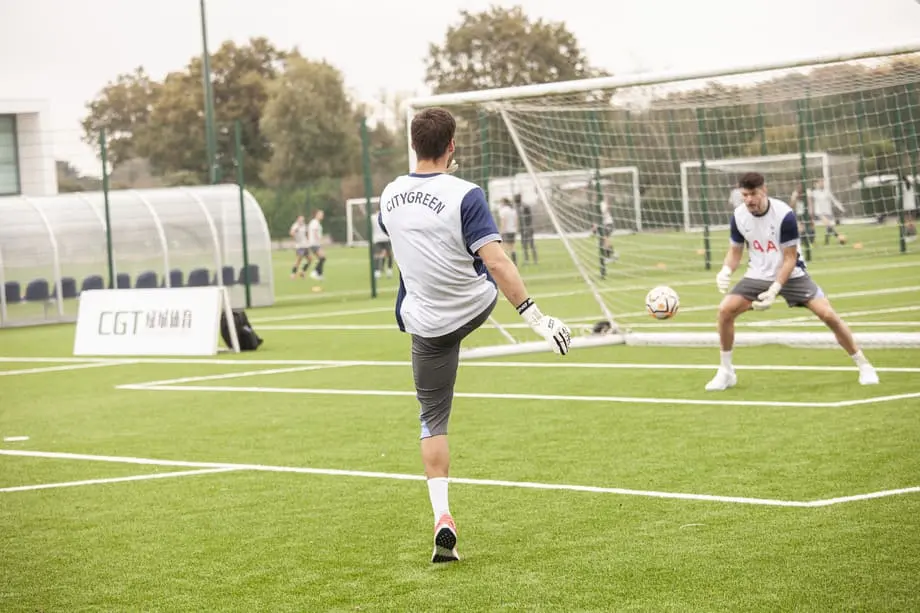
intensive football field usage affecting artificial turf lifespan
A community football field used several hours per week experiences very different stress compared with professional training centers operating daily with continuous player rotation. High-frequency use accelerates fiber wear, infill displacement, seam stress, and compaction of the underlying shockpad layers.
Lower-frequency recreational fields may maintain stable performance for well over a decade, while school or academy facilities with daily operation often require earlier renovation due to more intensive surface fatigue. In elite training environments, system design frequently prioritizes consistent playability and athlete performance over simply maximizing replacement timelines.
Modern football infrastructure increasingly demands systems capable of supporting intensive scheduling without significant performance degradation. This is why professional projects now place greater emphasis on structural engineering, shock absorption stability, and sub-base performance rather than relying solely on thicker turf fibers as a durability solution.
Turf Fiber Quality
Not all artificial grass fibers perform equally over time.
Fiber durability depends on multiple technical parameters, including:
- Polymer quality
- UV resistance
- Yarn shape
- Fiber density
- Stitch rate
- Backing stability
Lower-grade turf systems often suffer from early fiber flattening, splitting, color fading, or reduced resilience after prolonged exposure to sunlight and repetitive use.
High-quality monofilament systems with advanced UV stabilization generally maintain better vertical recovery and surface consistency over long-term operation.
In FIFA-oriented football systems, turf behavior must remain stable under both environmental exposure and repeated mechanical stress. This is particularly important in hot climates, high-UV regions, and intensive commercial facilities.
Base Structure and Drainage System
One of the most overlooked aspects of football turf lifespan is the quality of the sub-base and drainage structure.
Even premium turf fibers cannot compensate for poor foundational engineering.
Improper drainage can lead to water accumulation, sub-base movement, uneven settlement, and accelerated system deterioration. Over time, these structural issues affect surface flatness, player safety, and overall field performance.
Professional football fields typically require:
- Stable aggregate base construction
- Accurate grading tolerances
- Efficient water evacuation systems
- Controlled compaction standards
- Long-term structural stability
At CGT, drainage efficiency and foundational precision are treated as core performance variables rather than secondary construction details. Especially in regions with heavy rainfall or high seasonal variation, long-term system reliability depends heavily on substructure engineering quality.
Standard Football Turf vs FIFA-Level Systems
The difference between ordinary football turf systems and FIFA-standard systems extends far beyond certification labels.
Standard recreational systems are often optimized primarily around initial budget control. While suitable for light or moderate usage, they may experience faster performance decline under intensive operation.
By contrast, FIFA-oriented football systems are developed around significantly stricter technical performance requirements. Factors such as ball roll consistency, shock absorption, vertical deformation, surface traction, energy restitution, rotational resistance, and long-term playability stability all become critical parts of the system design process.
As a result, higher-level systems generally achieve better lifecycle durability despite higher initial investment. A professionally engineered FIFA-quality football field may cost more upfront, but the longer replacement cycle, reduced maintenance risk, and more stable performance often create significantly better long-term value.
This becomes especially important for clubs, municipalities, universities, and commercial sports operators planning multi-year facility operation, where field reliability and consistent performance directly influence both operational efficiency and user experience.
Lifecycle Cost Analysis of Artificial Football Turf
Many project owners focus heavily on initial installation cost while underestimating lifecycle economics. In reality, long-term operational value is usually far more important than short-term material savings.
A lower-cost football turf system may initially reduce project budget, but premature wear, drainage failure, seam repair, surface inconsistency, and earlier replacement cycles can generate substantially higher maintenance and operational costs over time.
For this reason, lifecycle cost analysis should evaluate the entire long-term performance of the facility rather than only the initial construction investment. Maintenance requirements, expected replacement timelines, repair frequency, downtime risk, usage capacity, and long-term operational revenue all play important roles in determining the actual value of a football turf system.
High-quality football turf systems often achieve lower cost per usage hour throughout the full lifecycle of the facility. For commercial football centers and training academies in particular, this becomes highly significant because field availability directly affects scheduling capacity and operational revenue.
In many modern sports infrastructure projects, durability is no longer viewed as an isolated material characteristic. Increasingly, it is evaluated as part of the overall operational efficiency, reliability, and long-term sustainability of the venue itself.
How System Design Can Extend Football Turf Lifespan
Long-term turf durability is heavily influenced by early-stage engineering decisions.
A well-designed football turf system distributes mechanical stress more effectively, improves drainage efficiency, reduces localized wear, and maintains more stable playability throughout its lifecycle.
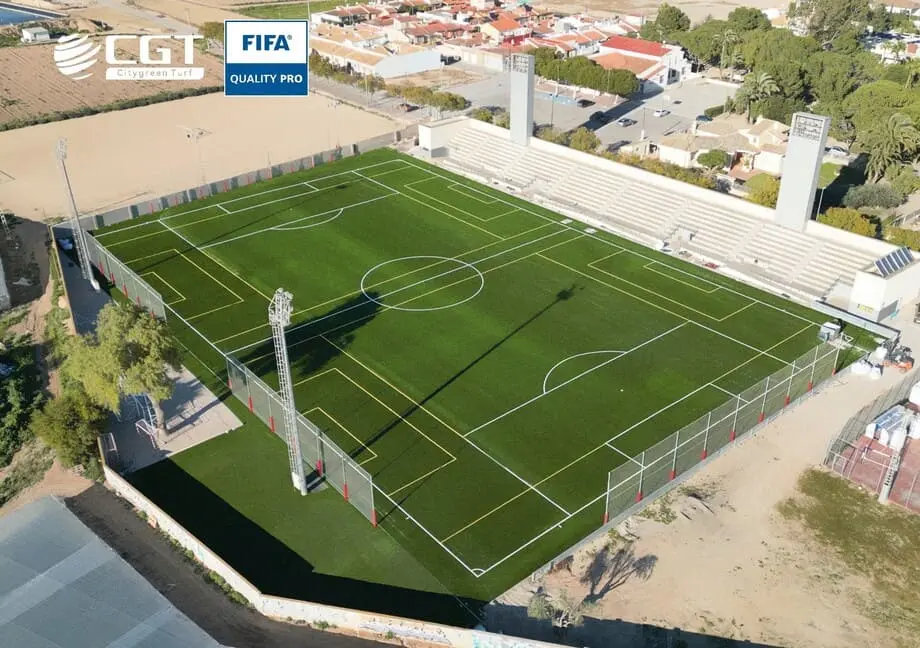
long-lasting artificial football turf field for professional sports infrastructure
Several design strategies can significantly extend field lifespan:
- Optimized shockpad systems
- High-density turf structures
- Balanced infill distribution
- Precision base construction
- Advanced drainage engineering
- Proper seam integration
- Climate-adapted material selection
The CGT system design is developed according to actual project operation scenarios rather than relying on standardized one-size-fits-all configurations.
Professional training facilities, school campuses, municipal stadiums, and commercial football centers all face different operational demands. System specifications are therefore adjusted based on expected usage intensity, climate conditions, maintenance capability, and long-term operational goals.
This engineering-oriented approach helps improve not only turf durability, but also long-term athlete comfort, performance consistency, and overall facility reliability.
Conclusion
Artificial football turf typically lasts between 8 and 15 years, but actual lifespan depends heavily on engineering quality, usage intensity, drainage performance, and system design.
Modern football infrastructure is no longer simply about installing synthetic grass. Long-term success depends on how well the entire field system performs over years of continuous operation.
As football facilities continue evolving toward higher usage intensity and stricter performance expectations, durable and professionally engineered turf systems are becoming increasingly essential for sustainable sports infrastructure development.