

When people evaluate a football turf system, they usually focus on visible elements—grass quality, infill, or shock absorption. But one of the most critical determinants of long-term performance sits beneath the surface: the drainage system. Poor drainage is one of the most common causes of field failure, yet it’s often underestimated during planning and budgeting.
This article breaks down why drainage is critical, how different systems work, and what to consider when designing a high-performance football pitch.
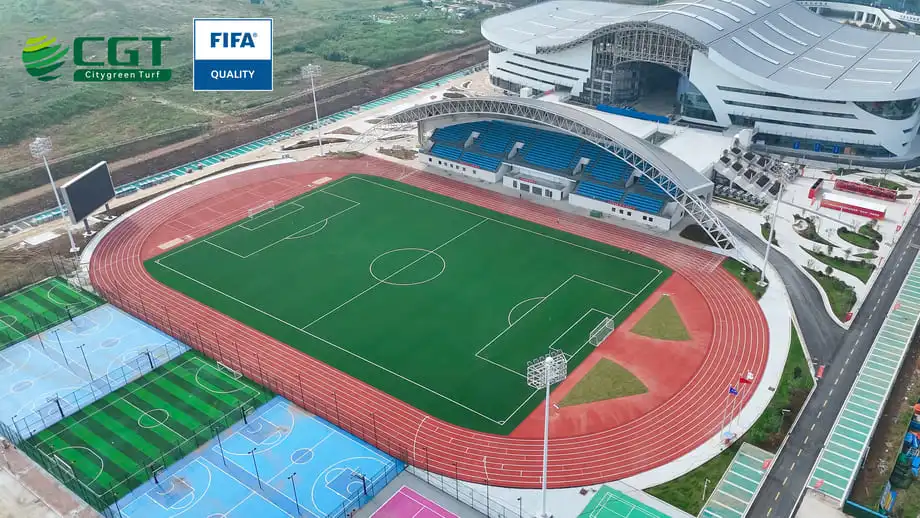
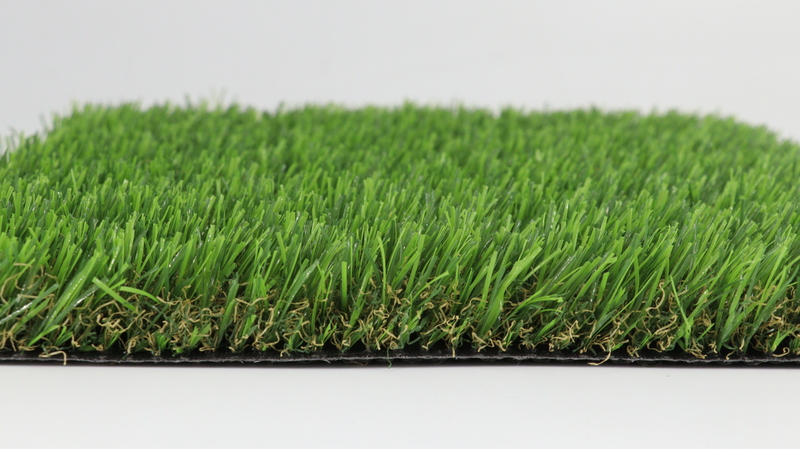
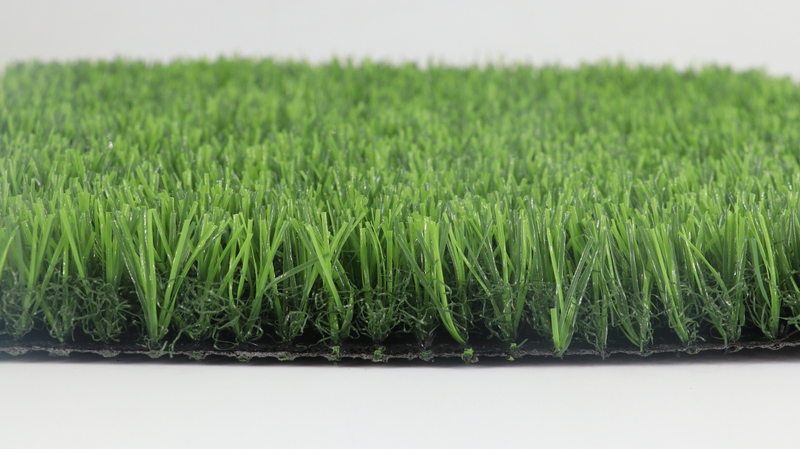
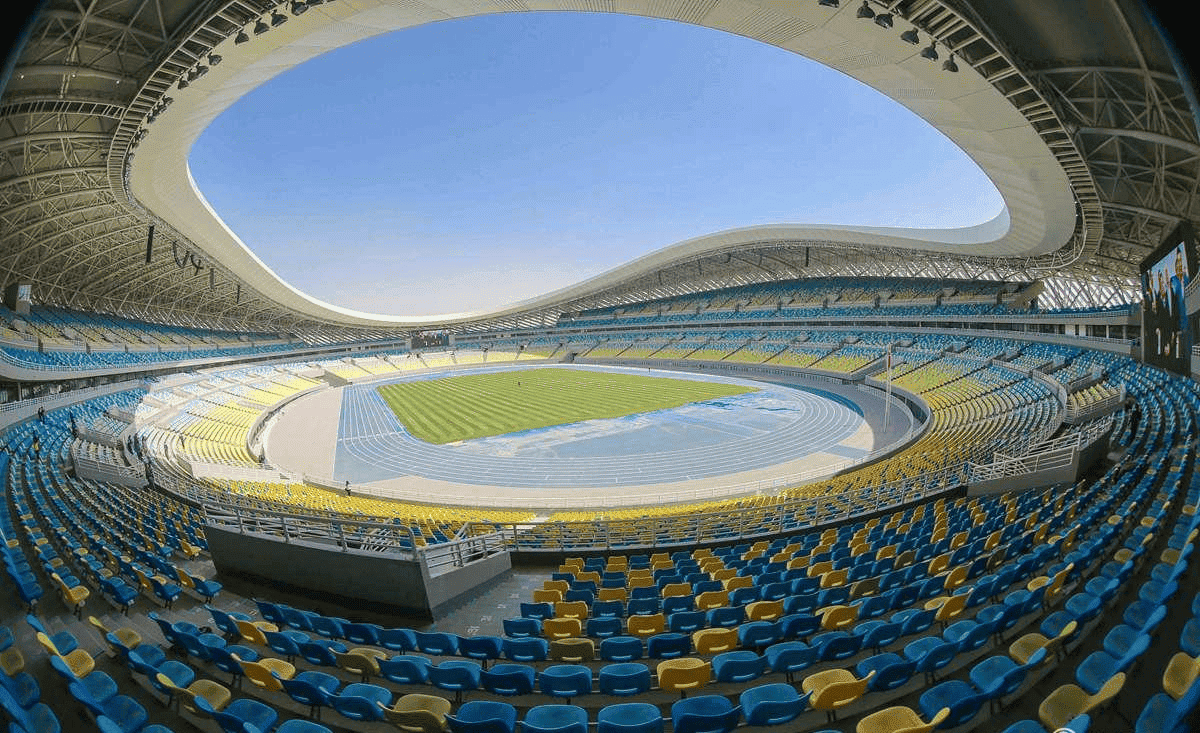
Completed football pitch project featuring a high-performance artificial turf system, supported by an integrated drainage design for all-weather playability.
Why Drainage Is Often Overlooked but Critical
Drainage is invisible once the field is completed, which is exactly why it gets ignored. Many projects prioritize surface performance for immediate visual impact but fail to consider how the system behaves under real weather conditions.
In reality, drainage affects almost every aspect of a football pitch—from playability and safety to lifecycle cost. A well-designed system ensures quick water evacuation, stable footing, and minimal downtime, while a poorly designed one can compromise even the highest-quality turf system.
Types of Football Turf Drainage Systems
Football turf drainage systems generally fall into three categories, often used in combination rather than isolation.
Natural infiltration relies on the permeability of the underlying soil to absorb water. This approach is cost-effective and suitable for areas with sandy soil and low rainfall, but its performance is highly dependent on local ground conditions and tends to decline over time due to compaction.
Engineered drainage layers are the most widely used solution today. By incorporating graded aggregates beneath the turf, these systems allow water to move vertically through the structure at a controlled rate. This not only improves drainage efficiency but also enhances load distribution, helping maintain field stability under frequent use.
For higher-performance fields, especially in wet climates or professional applications, pipe drainage systems are introduced. Perforated pipes installed beneath the base layer actively collect and channel water away from the pitch. When combined with filtration layers, they ensure long-term reliability and consistent drainage performance.
Key Design Considerations
Effective drainage design depends on the coordination of several technical factors rather than a single solution.
Surface slope plays a fundamental role. A gradient of around 0.5% to 1% is typically required to guide water toward drainage points. Without it, even high-quality systems can experience localized water accumulation.
Permeability is equally critical. The system must be capable of handling peak rainfall intensity, which means ensuring sufficient vertical drainage capacity through properly selected materials and layer design.
Finally, the base structure determines whether the system performs consistently over time. Proper compaction, correct layer thickness, and the use of angular aggregates all contribute to maintaining void space for water movement while preventing settlement and deformation.
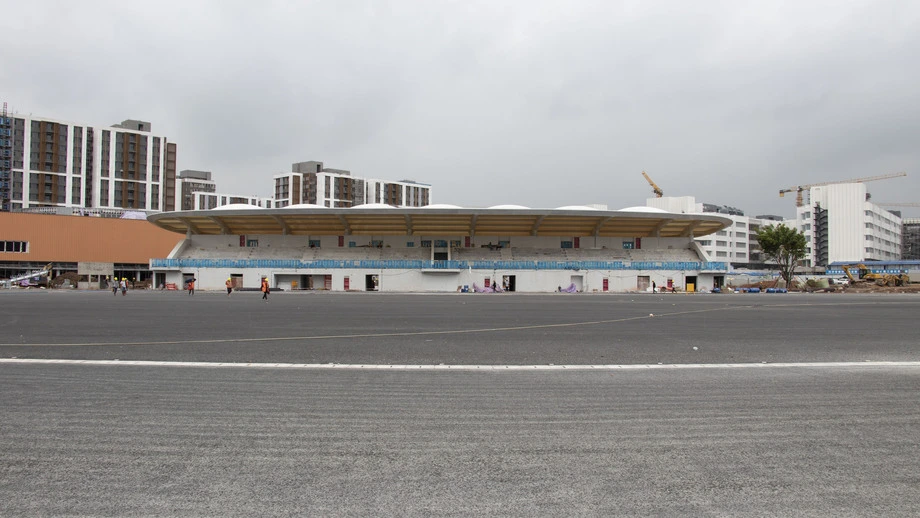
Early-stage football pitch construction showing the prepared base layer with visible drainage points prior to artificial turf installation.
Problems Caused by Poor Drainage
When drainage is inadequate, the issues are immediate and cumulative.
Surface water accumulation is the most visible problem, leading to puddles and disrupted play. Over time, excess moisture weakens the base layers, causing uneven surfaces and reducing the overall lifespan of the field.
Safety is also compromised. Wet and unstable surfaces increase the risk of slips and injuries, particularly during high-intensity play. In addition, maintenance costs rise significantly, as fields require more frequent repairs and experience longer downtime.
Ultimately, poor drainage doesn’t just affect performance—it undermines the entire investment.
Our Drainage Solutions for Professional Football Projects
Drainage performance becomes a critical factor in large-scale and professional football projects, where high usage intensity and challenging weather conditions place greater demands on the field system. In these scenarios, drainage is not an isolated feature, but a key part of overall pitch performance.
With extensive project experience, we provide integrated drainage solutions tailored to each project’s specific requirements. For stadiums and high-level training facilities, this includes coordinating base structure design with high-permeability materials and, where necessary, engineered pipe drainage systems to ensure rapid water evacuation and consistent playability under heavy rainfall.
Our approach focuses on solving real project challenges—such as water accumulation, surface instability, and long-term durability. By aligning turf systems with structural and drainage considerations from the outset, we help minimize maintenance issues, extend field lifespan, and ensure reliable performance throughout the year.
This capability allows us to support demanding football projects with solutions that go beyond standard specifications—delivering pitches that perform consistently under real-world conditions.
Conclusion
Drainage may not be visible, but it is foundational to the performance of any football turf system. From ensuring playability after rain to protecting the structural integrity of the field, its impact is continuous and far-reaching.